衣資具
| CHAPTER TWO | 第二章 |
Cloth Requisites
|
衣資具
|
| A bhikkhu has four primary requisites—robe-cloth, food, lodgings, and medicine—and a variety of secondary ones. This and the following five chapters discuss requisites that are allowable and not, along with the proper use of allowable requisites. The suttas provide a background for these discussions by highlighting the proper attitudes that a bhikkhu should develop toward his requisites: He should reflect on their role, not as ends in themselves, but as mere tools toward the training of the mind; and he should develop an attitude of contentment with whatever requisites he receives. | 比丘有四種主要資具——衣、食、住處、藥——以及多種次要資具。本章及隨後的五章將探討哪些資具是允許使用的,哪些是不允許的,並如何適當地使用那些允許的資具。經文為這些討論提供了背景,強調了比丘在對待資具時應培養的正確態度:他應當省察資具的作用,視其為心修行的工具,而非目的本身;同時,無論獲得何種資具,他都應培養知足的心態。 |
“And what are the effluents to be abandoned by using? There is the case where a bhikkhu, reflecting appropriately, uses robe-cloth simply to counteract cold, to counteract heat, to counteract the touch of flies, mosquitoes, wind, sun, and reptiles; simply for the purpose of covering the parts of the body that cause shame.
|
「那麼,透過使用而捨棄的煩惱[漏]有哪些呢?即:比丘如理省察,使用衣物僅僅是為了抵禦寒冷、炎熱,抵禦蚊蠅、風、陽光及爬蟲的侵擾;僅僅是為了遮蔽身體羞恥部位。
|
“Reflecting appropriately, he uses almsfood, not playfully, nor for intoxication, nor for putting on bulk, nor for beautification; but simply for the survival and continuance of this body, for ending its afflictions, for the support of the holy life, thinking, ‘Thus will I destroy old feelings (of hunger) and not create new feelings (from overeating). I will maintain myself, be blameless, and live in comfort.’
|
「如理省察,他受用施食:既非為了嬉戲,亦非為了沉醉、增肌或美化;而僅是為了維持此色身的存續、消除身體的苦痛,並以此支持梵行生活。思惟:『以此,我將消除舊有的受(飢餓感),而不引發新的受(因過量進食);我將維持生命,保持無過失,並安適地生活。』
|
“Reflecting appropriately, he uses lodging simply to counteract cold, to counteract heat, to counteract the touch of flies, mosquitoes, wind, sun, and reptiles; simply for protection from the inclemencies of weather and for the enjoyment of seclusion.
|
「如理省察,他使用住處僅是為了抵禦寒暑,防避蚊蠅、風吹、日曬及爬蟲的侵擾;僅是為了抵禦惡劣天氣,並享受隱居獨處之樂。
|
“Reflecting appropriately, he uses medicinal requisites for curing the sick simply to counteract any pains of illness that have arisen and for maximum freedom from disease.
|
「如理省察,他使用醫藥資具來治療疾病,只是為了消除已生起的病痛,並力求最大限度地擺脫疾病。
|
“The effluents, vexation, or fever that would arise if he were not to use these things (in this way) do not arise for him when he uses them (in this way). These are called the effluents to be abandoned by using.”—MN 2
|
「若他不(以這種方式)使用這些事物而會生起漏、煩惱或狂熱,當他(以這種方式)使用它們時,便不會生起。這些被稱為『通過使用而捨棄的漏』。」——《中部》2經
|
“And how is a bhikkhu content? Just as a bird, wherever it goes, flies with its wings as its only burden, so too is he content with a set of robes to provide for his body and almsfood to provide for his hunger. Wherever he goes, he takes only his barest necessities along. This is how a bhikkhu is content.”—DN 2
|
「比丘如何知足呢?就像鳥兒無論飛往何處,唯一的負擔便是雙翼;同樣地,他以一套袈裟蔽體、以托缽所得之食充飢,便感到滿足。無論去往何處,他只攜帶最基本的生活必需品[資具]。這就是比丘如何知足。」——《長部》2經
|
“‘This Dhamma is for one who is content, not for one who is discontent.’ Thus was it said. With reference to what was it said? There is the case where a bhikkhu is content with any old robe-cloth at all, any old almsfood, any old lodging, any old medicinal requisites for curing the sick at all. ‘This Dhamma is for one who is content, not for one who is discontent.’ Thus was it said. And with reference to this was it said.”
— AN 8:30
|
「『此法是為知足者而設,非為不知足者而設。』這是如此所說的。這是針對什麼而說的呢?有此情況,比丘對於任何種類衣料、任何種類托缽所得之食、任何種類住所、任何種類治療疾病的醫藥資具,皆能知足。『此法是為知足者而設,非為不知足者而設。』這是如此所說的。這是針對如此而說的。」 |
| Furthermore, for a bhikkhu truly to embody the traditions of the noble ones, he should not only be reflective and content in his use of the requisites, but he should make sure that his reflection and contentment do not lead to pride. | 此外,比丘若要真正體現聖者的傳統,不僅在受用資具時應保持省察與知足,還須確保這種省察與知足不致引發傲慢。 |
“There is the case where a bhikkhu is content with any old robe-cloth… any old almsfood… any old lodging at all. He does not, for the sake of robe-cloth… almsfood… lodging, do anything unseemly or inappropriate. Not getting robe-cloth… almsfood… lodging, he is not agitated. Getting robe-cloth… almsfood… lodging, he uses it unattached to it, uninfatuated, guiltless, seeing the drawbacks (of attachment to it), and discerning the escape from them. He does not, on account of his contentment with any old robe-cloth… almsfood… lodging at all, exalt himself or disparage others. In this he is diligent, deft, alert, & mindful. This is said to be a bhikkhu standing firm in the ancient, original traditions of the noble ones.”
— AN 4:28
|
「有這樣一種情形,比丘對任何衣料…任何托缽所得的食物…任何住所都感到知足。他不會為了衣料…托缽食物…住所而做出任何不體面或不恰當的行為。若未得到衣料…托缽食物…住所,他不會心生煩惱;若得到了衣料…托缽食物…住所,他在受用時也不生執著或迷戀,而是清白無咎,既能洞見(因執著而產生的)過患,又能明辨解脫其之道。由於對任何舊的衣料、乞食所得的食物以及住所都感到滿足,他既不抬高自己,也不貶低他人。在這方面,他精進、善巧、警覺且保持正念。這就是所謂的堅定地恪守聖者們古老而原始傳統的比丘。」 |
| In this way, the requisites fulfill their intended purpose—as aids, rather than obstacles, to the training of the mind. | 如此一來,這些資具都能實現其既定目的——即作為修行心的輔助工具,而非障礙。 |
Robe material
|
袈裟材質
|
| A candidate for ordination must have a set of robes before he can be admitted to the Community as a bhikkhu (Mv.I.70.2). Once ordained he is expected to keep his robes in good repair and to replace them when they get worn beyond use. | 受具足戒者人選必須備妥一套袈裟,方能獲准加入僧團成為比丘(《大品》.一.70.2)。受具足戒之後,他須妥善維護袈裟,若袈裟破損至無法使用,則須予以更換。 |
| The robes may be made from any of six types of robe material: linen, cotton, silk, wool, jute, or hemp (Mv.VIII.2.1). As noted under the discussion of NP 1, the Sub-commentary to that rule includes mixtures of any or all of these types of cloth under “hemp.” There are separate allowances for cloaks, silk cloaks, woolen shawls, and woolen cloth (Mv.VIII.1.36-2.1), but these apparently predated and should be subsumed under the list of six. Nylon, rayon, and other synthetic fabrics are now accepted under the Great Standards. | 袈裟可由六種材質中的任一種製成:亞麻、棉、絲、羊毛、黃麻或大麻(《大品》.八.2.1)。如同在討論《捨墮》一時所指出的,該戒條的《複註》將上述各種織物(無論是其中一種還是多種的混合)均歸入「大麻」這一類別。雖然針對斗篷、絲製斗篷、羊毛披肩及羊毛織物另有單獨的開緣(《大品》.八.1.36-2.1),但這些開緣顯然早於上述六種材質的分類,且應被納入該六類之中。依據《四大教示》,尼龍、人造絲及其他合成纖維織物現已被接受。 |
| A bhikkhu may obtain cloth by collecting cast-off cloth, accepting gifts of cloth from householders, or both. The Buddha commended being content with either (Mv.VIII.32). | 比丘可以拾取廢棄布料、接受在家居士布施的布料,或兼採這兩種方式來獲取布料。佛陀讚許對這兩種方式中的任一種感到知足(《大品》.八.32)。 |
| Robes made from cast-off cloth are one of the four supports, or nissaya, of which a new bhikkhu is informed immediately after ordination. Keeping to this support is one of the thirteen dhutaṅga practices (Thag&16:7). Mv.VIII.4 contains a series of stories concerning groups of bhikkhus who, traveling together, stop and enter a charnel ground to gather cast-off cloth from the corpses there. The resulting rules: If a group goes in together, the members of the group who obtain cloth should give portions to those who don’t. If some of the bhikkhus enter the charnel ground while their fellows stay outside or go in afterward, those who enter (or enter first) don’t have to share any of the cloth they obtain with those who come in afterwards or stay outside and don’t wait for them. However, they must share portions of the cloth they obtain if their fellows do wait or if they have made an agreement beforehand that all are to share in the cloth obtained. The Commentary to Pr 2 discusses the etiquette for taking a piece of cloth from a corpse: Wait until the corpse is cold, to ensure that the spirit of the dead person is no longer in the body. | 由廢棄布料製成的袈裟,是新比丘在受具足戒後立即被告知的四種「依止」(nissaya)之一;堅持這一依止也是十三種「頭陀行」(dhutaṅga)之一(《長老偈》16:7)。《大品》.八.4 包含了一系列關於比丘群體結伴同行時,進入棄屍林(charnel ground)從屍體上拾取廢棄布料的故事。由此確立的戒條如下:若群體一同進入,獲得布料的群體成員應將部分布料分給未獲布料者;若部分比丘進入棄屍林,而同伴留在林外或隨後才進入,則進入者(或率先進入者)無需與隨後進入或留在林外且未等候他們的人分享所獲布料。然而,若同伴確實在等候,或眾人事先約定共同分享所獲布料,則必須分享部份所得布料。《波羅夷》二的《義註》探討了從屍體上取布的行儀:須等到屍體變冷,以確保死者的神識已不在軀體。 |
| As for gifts of robe-cloth, Mv.VIII.32 lists eight ways in which a donor may direct his/her gift of cloth: | 至於衣料布施,《大品》.八.32)列舉了布施者可指定其衣料布施用途的八種方式: |
1. within the territory,
|
1. 界場內,
|
2. within an agreement,
|
2. 在協議範圍內,
|
3. where food is prepared,
|
3. 準備食物的地方,
|
4. to the Community,
|
4. 給僧團,
|
5. to both sides of the Community,
|
5. 給兩邊僧團,
|
6. to the Community that has spent the Rains,
|
6. 給度過雨安居的僧團,
|
7. having designated it, and
|
7. 指定之,以及
|
8. to an individual.
|
8. 給個人。
|
| There are complex stipulations governing the ways in which each of these types of gifts is to be handled. Because they are primarily the responsibility of the robe-cloth-distributor, they will be discussed in Chapter 18. However, when bhikkhus are living alone or in small groups without an authorized robe-cloth-distributor, they would be wise to inform themselves of those stipulations, so that they can handle gifts of robe-cloth properly and without offense. | 對於每一種類型的布施,都有複雜的規定來規範處理方式。由於這些規定主要由袈裟衣料分配者負責,因此將在第十八章中討論。然而,當比丘獨居或在小群體裡,沒有被授權的袈裟衣料分配者時,他們最好了解這些規定,以便妥善處理布施的袈裟衣料,避免犯戒。 |
| Once a bhikkhu has obtained cloth, he should determine it or place it under shared ownership as discussed under NP 1, NP 3, and Pc 59. | 比丘一旦獲得布料,就應依照《捨墮》一、《捨墮》三和《波逸提》五九裡的討論,決意布料或將其置於共享所有權之下。 |
Making Robes: Sewing Instructions
|
製作袈裟:縫紉說明
|
| The basic set of robes is three: a double-layer outer robe, a single-layer upper robe, a single-layer lower robe. Up to two of these robes may be made of uncut cloth with a cut border (an anuvāta—see below). Robes without cut borders may not be worn; the same holds true for robes with long borders, floral borders, or snakes’ hood borders. If one obtains a robe without cut borders or with long borders, one may add the missing borders or cut the long borders to an acceptable size and then wear them. | 基本的袈裟組合包含三件:一件雙層外衣、一件單層上衣和一件單層下衣。其中最多兩件袈裟可採用「帶裁切邊的未裁切布料」(即 anuvāta ,見下文)的形製。不得穿著未裁切邊的袈裟;帶有長邊、花邊或蛇頸部皮褶邊的袈裟亦不得穿著。若獲得未裁切邊或長邊的袈裟,可補縫缺失的邊條,或將過長的邊條修剪至合規尺寸,方可穿著。 |
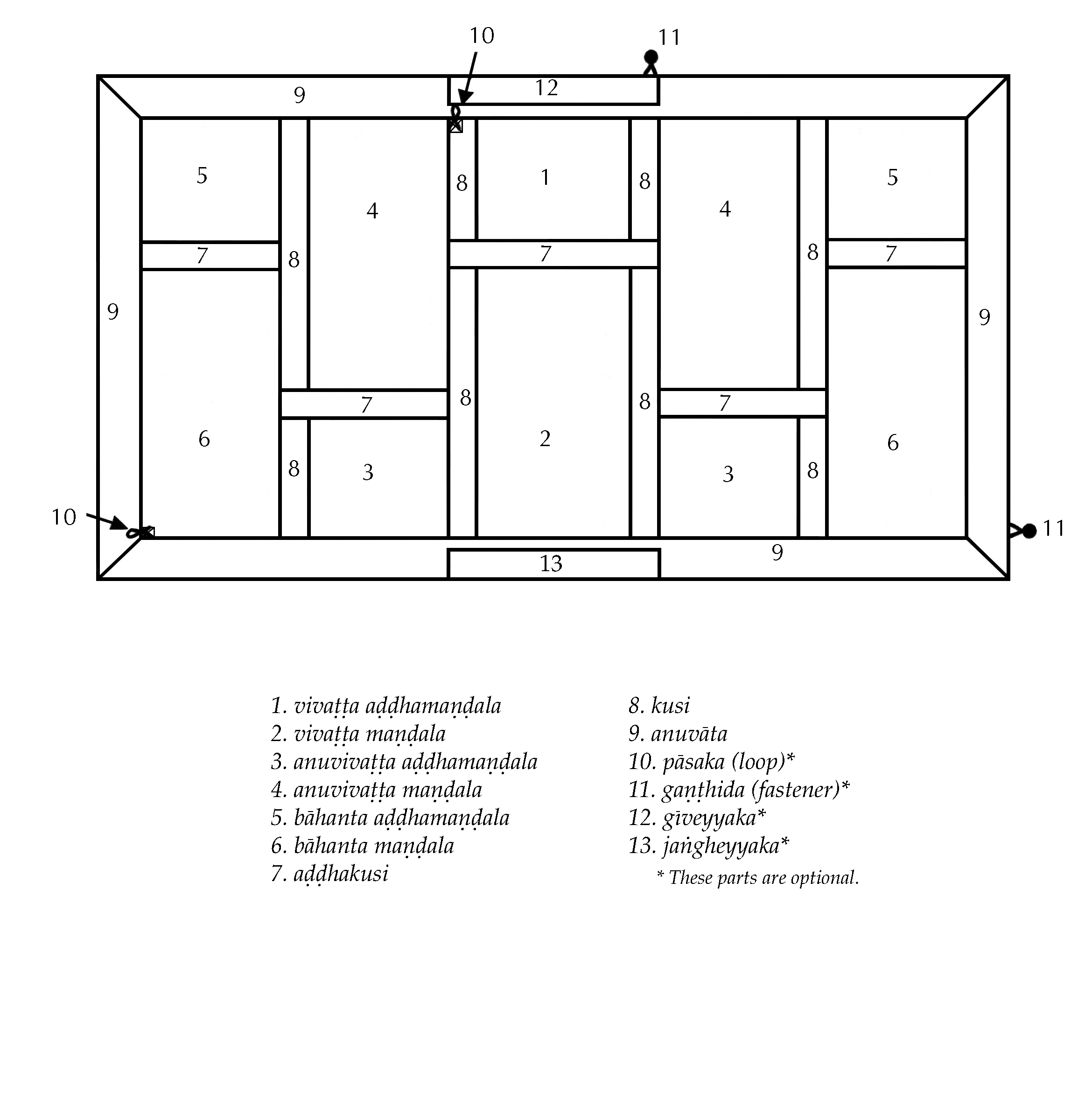
| At least one of the robes, however, must be cut. The standard pattern, “like the rice fields of Magadha,” was first devised by Ven. Ānanda at the Buddha’s suggestion. There is no penalty for not following the standard pattern, but keeping to the standard ensures that rag cloth robes will look uniform throughout the Community. It also encourages that large pieces of cloth will get cut, thus reducing the monetary value of any robes made from them and making them less likely to be stolen. See the accompanying diagram. | 然而,至少必須裁剪其中一件袈裟。標準的裁剪樣式,「如同摩揭陀的稻田」,最初是由阿難尊者在佛陀的建議下設計的。不遵循標準樣式並無懲罰,但遵守標準可以確保僧團內的破布袈裟看起來一致。此外,它還鼓勵裁剪大塊布料,從而降低用這些布料製成的袈裟的價值,並減少被盜的可能性。請參閱附圖。 |
| Each cut robe made to the standard pattern has at least five sections, called khaṇḍas. Although more than five khaṇḍas are allowed, only odd numbers should be used, and not even. The Canon lists names for the parts of the cut robe without explanation. The Commentary interprets them as follows: Each khaṇḍa is composed of a larger piece of cloth, called a maṇḍala (field-plot), and a smaller piece, called an aḍḍhamaṇḍala (half-plot), separated by a small strip, like the dike in a rice field, called an aḍḍhakusi (half-dike). Between each khaṇḍa is a long strip, again like the dike in a rice field, called a kusi (dike). None of the texts mention this point, but it is customary that if the maṇḍala is in the upper part of its khaṇḍa, the maṇḍalas in the neighboring khaṇḍas will be in the lower part of theirs, and vice versa. The central khaṇḍa is called the vivaṭṭa (turning-back); the two khaṇḍas on either side of it, the anuvivaṭṭas; and the remaining khaṇḍas, bāhantas (armpieces), as they wrap around the arms. An alternative interpretation, which the Commentary attributes to the Mahā Aṭṭhakathā, is that all khaṇḍas between the vivaṭṭa and the outermost khaṇḍas are called anuvivaṭṭas, while only the outermost khaṇḍas are called bāhantas. The entire robe is surrounded by a border, called an anuvāta. | 每件依照標準式裁切的袈裟至少包含五個部分,稱為 khaṇḍa 。雖然允許使用超過五個 khaṇḍa ,但只應使用奇數,而不應使用偶數。《聖典》列出了裁切的袈裟各部分的名稱,但沒有解釋。《義註》的解釋如下:每個 khaṇḍa 由一塊較大的布料,稱為 maṇḍala (田地)和一塊較小的布料,稱為 aḍḍhamaṇḍala (半田地)組成,兩者之間用一個小條隔開,如同稻田裡的溝渠,稱為 aḍḍhakusi (半溝渠)。每個 khaṇḍa 之間都有一個長條,同樣如同稻田裡的溝渠,稱為 kusi (溝渠)。沒有文獻提及這一點,但通常情況下,如果 maṇḍala 位於其 khaṇḍa 的上半部,則相鄰 khaṇḍa 中的 maṇḍala 便位於其下半部,反之亦然。中央 khaṇḍa 稱為 vivaṭṭa (迴轉);其兩側的 khaṇḍa 稱為 anuvivaṭṭa ;其餘 khaṇḍa 則稱為 bāhanta (手臂部份),因為它們環繞著手臂。另一種解釋(據《義註》記載出自《Mahā Aṭṭhakathā》)是,所有介於 vivaṭṭa 和最外面的 khaṇḍa 之間的 khaṇḍa 都稱為 anuvivaṭṭa ,而只有最外面的 khaṇḍa 才稱為 bāhanta 。整件袈裟環繞著一圈邊框,稱為 anuvāta 。 |
| Two remaining pieces are mentioned in the Canon, the gīveyyaka (throat-piece) and the jaṅgheyyaka (calf-piece). The Commentary gives two interpretations of these names. The first, which it prefers, is that these are extra layers of cloth, sewn respectively onto the upper robe at the anuvāta wrapping around the neck and onto the lower robe at the anuvāta rubbing against the calves, to protect the robes from the extra wear and tear they tend to get in those places. With the current large size of the upper robe, a jaṅgheyyaka is useful on its lower anuvāta as well. The second interpretation, which for some reason the Vinaya-mukha prefers, is that these pieces are, respectively, the vivaṭṭa and the anuvaṭṭas in the upper robe. | 《聖典》中還提到了剩餘的兩個部件,分別是 gīveyyaka (喉嚨部件)和 jaṅgheyyaka (小腿肚部件)。《義註》對這兩個名稱給了兩種解釋。第一種解釋,也是《義註》偏好的解釋,認為,這些是額外的布料層,分別縫在上衣環繞頸部的 anuvāta 和下衣摩擦小腿處的 anuvāta 上,以保護袈裟免受那些地方容易造成的額外磨損。鑑於目前上衣尺寸較大,在其下方 anuvāta 上的 jaṅgheyyaka 也是有用的。第二種解釋(不知何故,《戒律入口》偏好這種解釋)認為,這些部件分別是上衣的 vivaṭṭa 和 anuvaṭṭa[譯註:似乎為打字錯誤,應該是 anuvivaṭṭa ] 。 |
| If one needs to make a cut robe but the amount of cloth available is enough only for an uncut robe (i.e., folding the edges of the cut pieces to make a proper seam would use up too much of the cloth), one may use a seam-strip to connect the pieces. This is apparently a long narrow strip of material to which one could stitch the cut pieces without folding them. | 如果需要製作一件裁剪的袈裟,但布料數量只夠做一件未裁剪的袈裟(也就是說,如果把裁剪好的布片邊緣折疊縫合,會用掉太多布料),可以使用縫合條來連接布片。縫合條明顯地是一條細長的材料條,可以將裁剪好的布片縫合在上面,而無需折疊。 |
| Pc 92 sets the maximum size for robes at 6x9 sugata spans. See the discussion under that rule. | 《波逸提》九二將家的最大尺寸設定為 6x9 善逝張手。請參閱該戒條下的討論。 |
| A fastener paired with a cloth/thread loop to hold the fasteners may be added to the robe at the neck, and another fastener-loop pair at the lower corners. The fasteners should not be made of fancy materials. Allowable materials are the standard list of ten (mentioned under “Ears” in the preceding chapter) plus thread or cord (tied into a knot). Cloth backings for the fasteners and loops are allowed, to strengthen them. For the fasteners and loops connecting the lower corners of the robe, the cloth backing for the fastener should be put at the edge of the robe, and the cloth backing for the tying loops seven or eight fingerbreadths in from the edge at the other corner. | 袈裟頸部處可加上搭扣並配上用於固定搭扣的布/線環圈;下方角落也可加上另一對搭扣及環圈。搭扣不應使用精美的材料。允許使用的材料為前一章「耳朵」部分所述的十種標準材料,外加線或繩(打成一個結)。允許在搭扣和環圈處用底布以增強其強度。連接袈裟下方角落的搭扣及環圈,搭扣的底布應位於袈裟邊緣,而在另一角落繫搭扣的環圈的底布則應位於距離邊緣七八指寬的位置。 |
Repairing Robes
|
修補袈裟
|
| When robes become ragged and worn, one is encouraged to patch them, even—if necessary—to the extent of turning a single-layer robe into a double-layer robe, and the double-layer outer robe into a four-layer one. One is also encouraged to get as much patching material as needed from cast-off cloth and shop-remnant cloth. Mv.VIII.14.2 lists five allowable means of repairing damaged cloth: patching, stitching, folding, sealing (with wax? tree gum?), and strengthening. As often happens with the technical vocabulary of sewing and other skills, there is some doubt about a few of these terms, especially the fourth. The Commentary defines the first as adding a patch after cutting out the old, damaged cloth; and the last as adding a patch without removing the damaged part. Folding would probably cover folding the cloth next to a rip or a frayed edge over the damaged part and then stitching it. Mv.VIII.21.1 lists four additional ways of repairing damaged cloth: a thread patch (darning), the removing of an uneven edge (according to the Commentary, this refers to cases where one of two pieces at the edge of the robe gets pulled out longer than the other when a thread gets yanked), a border and a binding for the edge of the border (to strengthen a frayed edge), and a network of stitches (the Commentary says that this is a network sewn like the squares on a chess board to help keep two pieces of cloth together; it probably refers to the network of stitches that forms the basis for darning a hole). | 當袈裟破舊不堪時,被鼓勵自己修補,甚至必要時,可以將單層袈裟改成雙層,將雙層外衣改成四層。也被鼓勵盡可能從廢棄布料和店鋪剩餘布料來獲取所需修補材料。《大品》.八.14.2 列出了五種允許的修補破損布料的方法:修補、縫合、折疊、密封(用蠟?樹膠?)和加強。正如縫紉和其他技藝的專業術語中經常出現的情況一樣,其中一些術語的含義存在一些疑問,尤其是第四個。《義註》將第一種定義為在剪掉舊的破損布料後添加補丁;將最後一種定義為在不移除破損部分的情況下添加補丁。折疊可能是指將布料沿著撕裂處或磨損邊緣折疊覆蓋破損部分,然後再進行縫合。《大品》.八.21.1 列出了修補破損布料的另外四種方法:用線縫補(織補)、去除不均勻的邊緣(根據《義註》,這是指當線被拉扯時,袈裟邊緣的兩塊布料中的一塊比另一塊長的情況)、邊框和邊框邊緣的包邊(以加固磨損的邊緣)以及縫線網(《義註》說,這是一種像國際象棋棋盤上的方格一樣縫製的網,以幫助將兩塊布料固定在一起;它可能是指構成織補破洞基礎的縫線網)。 |
Making Robes: Sewing Equipment
|
製作袈裟:縫紉設備
|
| One is allowed to cut cloth with a small knife with or without a handle. According to the Commentary, folding knives come under “knife with a handle,” and scissors would probably come here as well. Needles and thimbles may be used in sewing. At present, sewing machines have been accepted under the Great Standards. Knife-handles and thimbles may not be made of fancy materials. Allowable materials are the standard list of ten. To protect these items, one is allowed a piece of felt to wrap the knife and a needle tube for the needles; Pc 60 also indicates that a needle box would be one of a bhikkhu’s standard requisites, although none of the texts explain the difference between the box and the tube. Because Pc 86 forbids needle boxes made of bone, ivory, or horn, both the tube and the box could apparently be made of any of the seven remaining materials in the standard list of ten. | 允許使用有帶柄或沒有帶柄的小刀裁剪布料。根據《義註》,折疊刀屬於「帶柄刀」的範疇,剪刀也可能屬於此類。針和頂針可用於縫紉。目前,縫紉機根據《四大教示》已被接受。刀柄和頂針不得使用華麗的材質製成。允許使用的材料是十種標準材料列表。為了保護這些物品,允許使用一塊氈布來包裹刀,並使用針管存放針;《波逸提》六十還顯示,針盒是比丘的標準必需品之一,儘管沒有任何文獻解釋針盒和針管之間的區別。由於《波逸提》八六禁止使用骨頭、象牙或角製成的針盒,因此針管和針盒顯然都可以使用十種標準材料列表中剩餘的七種材料中的任何一種來製成。 |
| Cv.V.11.2 reports that various substances were used without success to keep needles from rusting—filling the needle tube with yeast, with dried meal, with powdered stone—and the bhikkhus finally settled on powdered stone pounded with beeswax. The Commentary reports that dried meal mixed with turmeric is also an effective rust deterrent. To keep the powdered stone mixture from cracking, one may encase it in a cloth smeared with beeswax. The Commentary reports that the Kurundī includes any cloth-case under “cloth smeared with beeswax,” while the Commentary itself also includes knife-sheaths under this allowance. | 《小品》.五.11.2 記載,各種物質曾被使用來防止針生鏽,例如在針管內填充酵母、乾麵粉和石粉,但都沒有成功。最終,比丘們選擇了用蜂蠟搗碎的石粉。《義註》中記載,乾粗磨粉與薑黃混合也是一種有效的防鏽劑。為了防止石粉混合物開裂,可以將其包裹在塗抹了蜂蠟的布中。《義註》中提到,《Kurundī》將任何布套都歸入「塗抹了蜂蠟的布」的範疇,而《義註》本身也將刀鞘也歸入此開緣。 |
| To keep these items from getting lost, one is allowed small containers for storing them. To keep the containers orderly, one is allowed a bag for thimbles, with a cord for tying the mouth of the bag that, when the mouth of the bag is closed, can be used as a carrying strap. | 為了防止這些物品遺失,允許使用小容器存放它們。為了保持容器整齊有序,允許使用頂針袋,袋子上帶有一條繩子,用於繫緊袋口;袋口閉合時,該繩子可用作提把手。 |
| To keep cloth aligned while sewing it, one is allowed to use a frame, called a kaṭhina, attached with strings for tying down the pieces of cloth to be sewn together. According to the Commentary, these strings are especially useful in sewing a double-layer robe. Apparently, a Community would have a common frame used by all the bhikkhus, as there are many rules covering its proper use and care. It is not to be set up on uneven ground. A grass mat may be placed under it to keep it from getting worn; and if the edges of the frame do wear out, a binding may be wrapped around them to protect them. If the frame is too big for the robe to be made, one may add extra sticks within the frame to make a smaller frame to the right size. There are also allowances for cords to tie the smaller frame to the larger frame, for threads to tie the cloth to the smaller frame, and for slips of wood to be placed between two layers of cloth. One may also fold back the mat to fit the smaller frame. A ruler or other similar measuring device is allowed to help keep the stitches equidistant; and a marking thread—a thread smeared with turmeric, similar to the graphite string used by carpenters, says the Commentary—to help keep them straight. | 為了在縫製過程中保持布料對齊,可以使用一種稱為「kaṭhina」的框架,框架上繫有繩子,用來捆綁待縫製在一起的布片。根據《義註》,這些繩子在縫製雙層袈裟時尤其有用。顯然,一個僧團會有一個所有比丘共用的框架,因為有許多關於框架正確使用和保養的戒條。框架不能架設在不平坦的地面上。可以在框架下舖一塊草蓆,以防止磨損;如果框架邊緣磨損,可以用滾邊包起來保護。如果框架太大,無法縫製袈裟,可以在框架內添加額外的棍子,將其縮小到合適的尺寸。此外,還允許使用繩子將小框架連接到大框架上,用線將布料固定在小框架上,以及在兩層布料之間放置木條。也可以將蓆子折疊起來,使其適合較小的框架。允許尺或其他類似的測量工具來幫助保持針腳等距;也可以使用標記線(一種塗有薑黃的線,類似於木匠使用的石墨線,《義註》中如此寫道)來幫助保持針腳筆直。 |
| There is a dukkaṭa for stepping on the frame with unwashed feet, wet feet, or shod feet. This indicates that the frame is meant to be placed horizontally on the ground when in use. The frame is apparently jointed, for when not in use it may be rolled or folded up around a rod, tied with a cord, and hung from a peg in the wall or an elephant-tusk peg. A special hall or pavilion may be built for storing and using the frame. This is discussed in Chapter 7. | 用未洗的腳、濕腳或穿鞋的腳踩踏框架,犯《突吉羅》。這表明框架在使用時應水平放置在地面上。框架顯然是接合式的,因此不用時可以捲起或折疊起來,繞在桿子上,用繩子捆紮,然後掛在牆上的釘子或象牙釘上。可以建造專門的廳堂或亭子來存放和使用框架。這在第七章中有討論。 |
Making Robes: Dyeing
|
製作袈裟:染色
|
| Robes of the following colors should not be worn: entirely blue (or green—the Commentary states that this refers to flax-blue, but the color nīla in the Canon covers all shades of blue and green), entirely yellow, entirely blood-red, entirely crimson, entirely black, entirely orange, or entirely beige (according to the Commentary, this last is the “color of withered leaves”). Apparently, pale versions of these colors—gray under “black,” and purple, pink, or magenta under “crimson”—would also be forbidden. As white is a standard color for lay people’s garments, and as a bhikkhu is forbidden from dressing like a lay person, white robes are forbidden as well. The same holds true for robes made from patterned cloth, although the Vinaya-mukha makes allowances for subtle patterns, such as the ripple pattern called “squirrel’s tail” that Thais sometimes weave into their silk. The Commentary states that if one receives cloth of an unallowable color, then if the color can be removed, remove it and dye the cloth the proper color. It is then allowable for use. If the color can’t be removed, use the cloth for another purpose or insert it as a third layer inside a double-layer robe. | 以下顏色的袈裟不應穿著:純藍色(或綠色——《義註》指出這指的是亞麻藍,但《聖典》中 nīla 該顏色涵蓋了所有藍色和綠色色調)、純黃色、純血紅色、純深紅色、純黑色、純橙色或純米色(根據《義註》,最後一種是「枯葉的顏色」)。顯然,這些顏色的淺色版本——「黑色」下的灰色,以及「深紅色」下的紫色、粉紅色或洋紅色——也是被禁止的。由於白色是居士服裝的標準顏色,而比丘被禁止穿著得像居士,因此白色袈裟也是被禁止的。同樣的道理也適用於由有圖案的布料製成的袈裟,儘管《戒律入口》允許一些細微的圖案,例如泰國人有時會在絲綢上織入的被稱為「松鼠尾」的波紋圖案。《義註》指出,如果收到不被允許的顏色的布料,如果可以去除顏色,則應去除顏色並將布料染成合適的顏色。這樣,布料就允許使用了。如果顏色無法去除,則應將布料用於其他用途,或將其作為第三層縫入雙層袈裟中。 |
| The standard color for robes is brown, although this may shade into reddish, yellow-, or orange-brown. In an origin story, bhikkhus dyed their robes with dung and yellow clay, and the robes came out looking wretched. So the Buddha allowed six kinds of dye: root-dye, stem (wood) dye, bark-dye, leaf-dye, flower-dye, fruit-dye. The Commentary notes, however, that these six categories contain a number of dyes that should not be used. Under root dyes, it advises against turmeric because it fades quickly; under bark dyes, Symplocos racemosa and Mucuna pruritis because they are the wrong color; under wood dyes, Rubia munjista and Rottleria tinctora for the same reason; under leaf dyes, Curculigo orchidoidis and indigo for the same reason—although it also recommends that cloth already worn by lay people should be dyed once in Curculigo orchidoidis. Under flower-dyes, it advises against coral tree (Butea frondosa) and safflower because they are too red. Because the purpose of these dye allowances is that the bhikkhus use dyes giving a fast, even color, commercial chemical dyes are now accepted under the Great Standards. | 袈裟的標準顏色是棕色,但也可能呈現偏紅、偏黃或偏橙的棕色調。在起源故事裡,比丘們用糞便和黃黏土來染袈裟,結果染出來的袈裟看起來糟透了。於是,佛陀准許使用六類染料:根、莖(木)、樹皮、葉、花、果實。然而,《義註》指出,這六類包含一些不應使用的染料。在根類染料中,因薑黃(turmeric)易褪色而不予推薦;在樹皮類染料中,因顏色不當而不推薦使用珠仔樹(Symplocos racemosa)和黧豆(Mucuna pruritis);在木材類染料,因同樣原因而不推薦梵茜草(Rubia munjista)和粗糠柴(Rottleria tinctora);在葉類染料中,因同樣原因而不推薦仙茅(Curculigo orchidoidis)和靛藍(indigo)——儘管《義註》也建議,對於在家居士穿過的布料,應先用仙茅染過一次。在花類染料中,因顏色過紅而不建議使用紫礦(Butea frondosa)和紅花(safflower)。因為允許這些染料的目的是讓比丘們使用能染出堅固且均勻顏色的染料,如今根據《四大教示》,商業化學染料也被接受。 |
| The following dyeing equipment is allowed: a small dye-pot in which to boil the dye, a collar to tie around the pot just under its mouth to prevent it from boiling over, scoops and ladles, and a basin, pot, or trough for dyeing the cloth. Once the cloth has been dyed, it may be dried by spreading it out on grass matting, hung over a pole or a line, or hung from strings tied to its corners. | 允許下列的染色用具:一個用於煮染料的小染鍋、一個綁在鍋口下方以防止染料溢出的項圈、勺子和長柄勺,以及一個用於染布的盆、罐或槽。染好的布料可以攤在草蓆上晾乾,也可以掛在桿子或繩子上晾乾,或是用繩子綁在布料的角落晾乾。 |
| The following dyeing techniques are recommended. When the dye is being boiled, one may test to see if it’s fully boiled by placing a drop in clear water or on the back of one’s fingernail. If fully boiled, the Commentary notes, the dye will spread slowly. Once the cloth is hung up to dry, one should turn it upside down repeatedly on the line so that the dye does not run all to one side. One should not leave the cloth unattended until the drips have become discontinuous. If the cloth, once dry, feels stiff, one may soak it in water; if harsh or rough, one may beat it with the hand. | 推薦下列的染色技巧。煮染料時,可滴一滴在清水中或指甲背面,以測試是否煮沸。《義註》指出,如果已完全煮沸,則會緩慢擴散。一旦把布掛起來晾乾,應在繩上反覆翻轉,以免染料全部流向一側。在染料滴落不再連續之前,不應讓布料無人看管。如果布料晾乾後感覺僵硬,可將其浸泡在水中;如果感覺粗糙或生硬,可用手拍打。 |
Washing Robes
|
洗袈裟
|
| The Commentary to Pr 2 notes that, when washing robes, one should not put perfume, oil, or sealing wax in the water. This, of course, raises the question of scented detergent. Because unscented detergents are often hard to find, a bhikkhu should be allowed to make use of what is available. If the detergent has a strong scent, he should do his best to rinse it out after washing. | 《波羅夷》二的《義註》指出,洗袈裟時,不應在水中加入香水、油或封蠟。這自然引出了有香味的洗滌劑的問題。由於無香味的洗滌劑往往難以取得,比丘應被允許使用現有可得之物。若洗滌劑香味濃厚,洗後應盡力沖洗乾淨。 |
Other Cloth Requisites
|
其他衣資具
|
| In addition to one’s basic set of three robes, one is allowed the following cloth requisites: a felt sitting rug (see NP 11-15); a sitting cloth (see Pc 89); a skin-eruption covering cloth (see Pc 90); and a rains-bathing cloth (see Pc 91). The following articles are also allowed and may be made as large as one likes: a sheet; a handkerchief (literally, a cloth for wiping the face/mouth); requisite-cloth; bags for medicine, sandals, thimbles, etc., with a cord for tying the mouth of the bag as a carrying strap; bandages (listed in the Rules section of Chapter 5); and knee straps. The Canon makes no mention of the shoulder cloth (aṁsa) that many bhikkhus wear at present. It would apparently come under the allowance for requisite-cloths (parikkhāra-cola). | 除了基本的「三衣」之外,比丘還被允許使用以下衣資具:毛氈坐具[敷具](參閱《捨墮》十一至十五)、坐布[坐具](參閱《波逸提》八九)、覆瘡布(參閱《波逸提》九十)以及雨浴衣(參閱《波逸提》九一)。此外,以下物品亦允許製作,且尺寸可根據喜好製作得任意大:床單;手巾(字面意為擦臉或擦嘴的布);資具布;用於盛裝藥物、涼鞋、頂針等物品的袋子,有繩子繫袋口,可用作提帶;繃帶(列於第五章「戒條」部分);以及膝帶。《聖典》中未提及當今許多比丘所穿戴的「肩衣」(aṁsa);它顯然應歸入「資具布」[雜用布](parikkhāra-cola)的允許範圍。 |
| According to the Commentary, the color restrictions applying to robes do not apply to sheets, handkerchiefs, or other cloth requisites. However, they do apply at present to shoulder cloths. | 根據《義註》,適用於袈裟的顏色限制並不適用於床單、手巾或其他衣資具。但是,目前這些限制確實適用於肩衣。 |
| There is some disagreement about which cloth items should be included under “requisite-cloth.” The Commentary allows that spare robes be determined as “requisite-cloth,” but these should be made to the standard size and follow the color restrictions for the basic set of three robes. The Vinaya-mukha prefers to limit the category of requisite-cloth to small cloth items such as bags, water strainers, etc. See the discussion of spare robes under NP 1. | 關於哪些布製品應歸入「必需布料」(requisite-cloth)範疇,存在一些分歧。《義註》允許將備用袈裟決意為「必需布料」,但這些備用袈裟必須符合標準尺寸,並遵循適用於基本三衣的顏色限制。《戒律入口》則傾向於將「必需布料」的範圍限定諸如像袋子、濾水器等小型布製品。請參閱《捨墮》一條目下關於備用袈裟的討論。 |
| The knee strap is a strip of cloth to help keep the body erect while sitting cross-legged. It is worn around the torso and looped around one or both knees. There is a prohibition against using the outer robe in this manner (see the origin story to Sg 6); and even if the strap is of an allowable sort, only an ill bhikkhu may use it while in an inhabited area (see Sk 26). To make knee straps, bhikkhus are allowed a loom, shuttles, strings, tickets, and all accessories for a loom. | 「膝帶」是一種布帶,用來幫助在盤腿而坐時保持軀幹挺直。使用時,將其圍在軀幹上,並套住單側或雙側膝蓋。戒條禁止將外衣當作膝帶使用(參見《僧殘》六的起源故事);即便所用的帶子符合規定,也僅限有病的比丘方可在俗家間使用(參見《應學》二六)。為了製作膝帶,比丘被允許擁有織布機、梭子、線繩、標籤以及織布機所需的一切配件。 |
| Two styles of waistband are allowed: cloth strips and “pig entrails.” According to the Commentary, the cloth strip may be made of an ordinary weave or a fish-bone weave; other weaves, such as those with large open spaces, are not allowed; a “pig-entrails” waistband is like a single-strand rope with one end woven back in the shape of a key-loop (apparently for inserting the other end of the waistband); a single-strand rope without the hole and other round belts are also allowed. The Canon forbids the following types of waistbands: those with many strands, those like a water-snake head, those braided like a tambourine frame, those like chains. | 允許使用兩種款式的腰帶:布條式和「豬內臟」式。根據《義註》,布條式腰帶可採用普通織法或魚骨織法;不允許使用其他織法(如帶有大孔隙的織法)。「豬內臟」式腰帶形似單股繩索,其一端編織回形成一個鑰匙環形狀(顯然是為了穿入腰帶的另一端);不帶孔的單股繩索以及其他圓形帶狀物也被允許。《聖典》禁止以下類型的腰帶:多股編織的腰帶、如同水蛇頭的腰帶、編織得如同鈴鼓框的腰帶,如同鏈條的腰帶。 |
| If the border of the waistband wears out, one may braid the border like a tambourine frame or a chain. If the ends wear out, one may sew them back and knot them in a loop. If the loops wear out, one is allowed a belt fastener, which must be made of one of the allowable materials in the standard list of ten. The Commentary to Pr 2 notes that the fastener should not be made in unusual shapes or incised with decorative patterns, letters, or pictures. | 如果腰帶邊緣磨損,可以像編織鈴鼓框或鏈條一樣將其編織起來。如果末端磨損,可以將其縫合回來並打結成環狀。如果環狀部分磨損,則允許腰帶扣,腰帶扣必須由標準列表中允許使用的十種材料之一製成。《波羅夷》二的《義註》指出,腰帶扣不應做成奇特的形狀,也不應刻有裝飾圖案、字母或圖畫。 |
Dressing
|
穿著
|
| There are rules concerning garments that may not be worn at any time, as well as rules concerning garments that must be worn when entering an inhabited area. | 對於任何時候都不得穿著的服裝,以及進入俗家間時必須穿著的服裝,都有相關的戒條。 |
Forbidden garments
|
禁止的服裝
|
| A bhikkhu who wears any of the following garments, which were the uniform of non-Buddhist sectarians in the Buddha’s time, incurs a thullaccaya: a kusa-grass garment, a bark-fiber garment, a garment of bark pieces, a human-hair blanket, a horse tail-hair blanket, owls’ wings, black antelope hide. The prohibition against black antelope hides covers other animal hides as well. | 比丘若穿著以下任何一種服飾(這些服飾在佛陀時代是非佛教宗派人士的裝束),犯《偷蘭遮》:茅草衣、樹皮纖維衣、樹皮碎片衣、人毛毯、馬尾毛毯、貓頭鷹翅膀、黑羚羊皮。禁止使用黑羚羊皮也適用於其他動物皮毛。 |
(未完待續)